Friday, October 26, 2012

Dog Yawning News


Bone Tired: Study Shows Yawning Dogs Empathizing with Owners

gty dog yawn ll 121025 wblog Bone Tired: Study Shows Yawning Dogs Empathizing with Owners

We’ve all heard that a dog’s bark can be worse than its bite, but what about its yawn?
It turns out that aspect of canine behavior may provide evidence that dogs really are man’s best friend. A study out of Lund University in Sweden found that our canine companions often yawn in reaction to seeing a human do the same thing.
The phenomenon, known as contagious yawning, is prominent among many groups of animals, humans included. However, the process, which is believed to indicate empathy and help contribute to group mentality and social structure, has been less studied between species.
Elainie Madsen, a doctor of psychology at Lund University who co-authored the study, told ABC News dogs were chosen because “they spend so much time with us, and we spend so much time with them.”
“For those of us who have dogs,” she said, “we often feel this very close connection with them, and we feel that they must understand or sympathize with our emotions and our emotional states.”
The study took 35 dogs between the ages of 4 and 14 months and exposed them to various yawning human beings. Madsen found the results fascinating.
“We showed that the dogs were yawning contagiously – not just yawning but they also took on the emotion that yawning usually signifies, which is usually sleepiness and tiredness,” she said.
As with humans, age proved to be a significant factor in whether or not a dog exhibited contagious yawning.
“They go through what seems to be an empathy development that somehow mirrors humans’ empathy development, so it’s just obviously on a very different time scale,” Madsen said. “Human children don’t begin to yawn contagiously until they’re about 4 years old. Below that age, they seem pretty immune to others yawning at them. In dogs, this happens when they’re about 7 months old. Dogs below that age don’t seem to yawn, either.”
So what does this mean for dog owners?
According to Madsen, it’s a reason to rest assured that your dog really does love you as much as you love it.
“Dogs really have a close emotional connection with people,” she said, “with owners as well as with other people.”


Thursday, October 11, 2012

Dog Saves Brother

Dog rescues brother trapped in Cape Cod woods


SANDWICH, Mass. A golden retriever who was trapped with his brother for two weeks in the woods on Cape Cod managed to find his way back home and lead his owner back to his sibling.

Baxter and Bailey were tied together with a double leash in front of their owner's Sandwich, Mass., home when they got loose on Sept. 26.

Owner Penny Blackwell put up flyers and appealed for help on Facebook, but after two weeks passed with no sign of the dogs, she began to lose faith that she would find them.

"I had pretty much given up hope that they were going to come home," Blackwell said.

Then, when Blackwell was out of town on business, she received a text message from a friend saying one of the dogs had been found. A family who had seen Blackwell's Facebook posts spotted Baxter wandering near their home.

And when Blackwell took Baxter back to where he'd been found, the golden retriever seemed to be on a mission to save his sibling.

"Baxter kind of led me off the side through the woods. I had twigs in my eyes and leaves in my hair," Blackwell said.

The dog led his owner right to Bailey, whose leash had become ensnared in bushes.

"I could hardly get him untied because he was jumping on me and jumping on Baxter because he was so happy to see us," Blackwell said.

The dogs each lost 8 to 10 pounds while they were missing but are otherwise in good health. And their owner is grateful to have them back.

"Baxter's a hero for taking me there," Blackwell said.


THAT DOG REALLY IS A     RETRIEVER!!!!


Tuesday, October 2, 2012

Pets and POT

‘Stoner dog’ epidemic sees dramatic rise in number of hospitalized pets


By Eric Pfeiffer

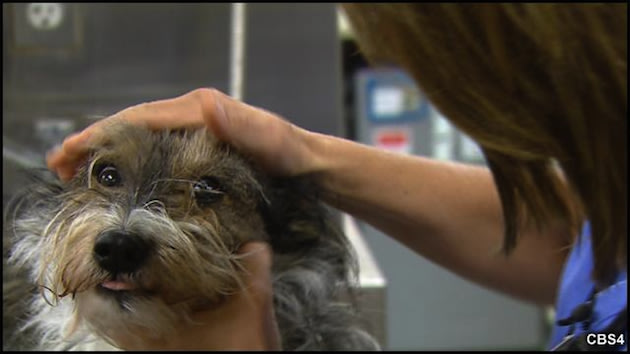
Getting your dog high on pot may be more akin to abuse than entertainment. (CBS4)Colorado veterinarians have a message for medical marijuana users: Don't get your dog stoned. Marijuana is toxic in a dog's system, they say, and has even resulted in some canine deaths.
"There are huge spikes in the frequency of marijuana ingestion in places where it's become legal," veterinarian Dr. Debbie Van Pelt told local CBS affiliate WTSP. "They basically have lost a lot of their fine motor control, they have a wide-based stance and they are not sure on their feet."
Before medical marijuana was legalized in Colorado, local vets say they saw only a handful of cases of dogs exposed to the substance per year. But now, those numbers have more than quadrupled.
The vets say most of the dogs are getting high from medical marijuana edibles left out in the open by their owners. Marijuana edibles are cookies, brownies and other foods prepared with a butter laced with THC, the psychoactive ingredient in pot.
And while some pet owners may think it's funny to get their dogs high, the vets say pot is actually toxic to a dog's system. Cats are similarly vulnerable to negative effects from inhaling second-hand marijuana smoke or eating edibles. Cat experts say many owners inaccurately believe that marijuana will have a similar effect on their cats as catnip.

"I just want dogs, kids to be safe. It needs to be treated like any other drug. If you came home with a prescription of Vicodin from your doctor you wouldn't just leave it sitting there," veterinarian Stacy Meola told the station.
In fact, Dr. Meola said that two dogs recently died after ingesting a lethal amount of marijuana. Such deaths are rare, but even in cases in which a dog's life is not threatened, the dog may still be subjected to painful symptoms, including vomiting and even comas.
"We need people to realize it is potentially toxic and potentially fatal to their pets," Van Pelt said.

Monday, September 24, 2012

PET EXPENSES CUT

The Dog Ate Your Wallet? How to Cut the Costs of Pet Ownership


• Put preventative care in your calendar. This can really cut costs in the long-run. Spay and neuter early on, shell out the cash for necessary vaccines, and subscribe to regular check-ups. And you can save here, too, mainly by calling around and comparing prices among vets. Other tips: Keep an eye on the calendars of local animal organizations -- many host events with free or low-cost shots. And ask your vet if her or she has samples of medications or manufacturer's rebates.

• Consider pet insurance. I like Aspros's rule of thumb: "Pet insurance makes the most sense for people who know that when a problem occurs, they're going to want to do the best thing for their pet, and yet they're going to have a hard time saving enough money to handle that calamity when it happens." In other words, if you would drain your bank account and max out your credit cards to save your pet's life, it's probably worth getting insurance.

• Shear the grooming expenses. When it comes to grooming, it goes without saying that I'm for DIY. Regular brushing will cut down on visits, and when you do visit the groomer, get their fur cut short -- it will take longer to grow out, thus pushing off your next visit. And if you board your dog, it's time to make friends with other pet owners, so you can swap care instead: They watch your pup while you're out of town this summer, you return the favor when they travel for business in the fall.

• Don't buy supplies new. Both Craigslist and yard sales are overflowing with leashes, bowls, collars and other items you need for less.


Sunday, September 23, 2012

Dog Killing in Russia


  • Text

Moscow police probe suspected mass dog poisoning

A muzzled dog plays in a Moscow park where dozens of dogs were killed in a mass poisoning, in this Thursday Sept. 20, 2012 photo. (AP Photo/Sergey Ponomarev)
(AP) MOSCOW - Vera Lesovets held up photographs of her dog, Yasha, a spunky 5-year-old corgi, nipping playfully at the heels of a German shepherd twice her size.
But Yasha's life was cut short this week: After snacking on something in a Moscow park, she fell into a seizure at Lesovets' apartment and began foaming at the mouth. The family rushed her to a nearby animal clinic, where the veterinarian said this was the sixth case he had seen that week, and there was nothing he could do.
On Friday police opened a criminal investigation into what they suspect are poisonings by dog killers. Cruelty to animals is common in Russia and animal protection laws are rarely enforced, but reports of as many as 70 dead dogs this week have spurred the police to take action.
While some residents suspected that a vigilante matriarch, wary of her children being bitten, might be the cause of the attacks, Lesovets was quick to suspect a more malicious culprit: dog hunters, a kind of deadly hobby gaining ground in the Russian online community.
Dog hunting forums — the most well-known of which are Vreditelyam.net and Pest.net — are populated by those who call themselves "volunteers" and provide graphic photos of their trophy killings. The sites require extensive registration and identification processes for participants.
"It's a whole community. They have websites," said Lesovets, an event manager. "They write how they kill them, post photographs, tell you which poison is better and where to buy it."
In the case of this neighborhood's dogs, the poison of choice was amanita phalloides, also known as the death cap mushroom, which has no known antidote and is dangerous for both animals and humans.
Before the attacks, the Pyatidesyatiletya Oktyabrya park in southwest Moscow — named to celebrate the 50th anniversary of the Bolshevik revolution — allowed residents to give their dogs a moment's respite from cramped city living and frolic without a leash in the grass or in the snow.
Owners no longer feel safe to do that, as the number of slain dogs keeps growing. Police estimates have ranged from 40 to 70 killings, based on complaints filed by owners. According to the website of one nearby veterinary clinic alone, they had received about 20 cases that week, 14 of them fatal.
The police were first notified of the poisonings early this week and formally opened a criminal investigation on Friday.
Masha Beshina was out walking her dog on Thursday when she discovered some pieces of ham suspiciously scattered in the part of the park where she usually walks her dog.
"Unfortunately the police don't take measures," said the middle-aged teacher. "Because for them a dog is not really something that exists."
Russian law calls for a prison sentence of up to two years for those who kill or abuse animals, but animal rights activists say it has been rarely enforced.
"We need investigative bodies, the police, the courts, the judges to start working," said Darya Khmelnitskaya, director of Virta, a charitable fund for animal welfare. "The legal clause already exists."
She said that one way to target dog killers would be to track IP addresses of the users who spread information about it online or shut down the sites completely. While some of the sites have been closed, information is still easily spread by individuals through websites such as Vkontakte, the largest Russian social network.
According to Khmelnitskaya, only nine cases against dog hunters in Moscow have made it to court since 2011, with just one ending in a conviction.
On the site Vreditelyam.net, now moved to the domain vredy.org, the owners state in their manifesto that they consider themselves keepers of the peace: Since Soviet times, the population of stray dogs, which now reaches an estimate of 25,000 in Moscow alone, has ballooned, and fear of bites and attacks has grown as well.
But just as the population of strays has grown, Muscovites also have long been a friend to many of the shaggy mutts. Dog hunting has touched a nerve in a society where stray animals have traditionally been ignored by the state and instead taken in by big-hearted citizens. One group established on Vkontakte in opposition to the dog hunters has attracted almost 4,000 members.
Most of the local residents said their dogs were former strays found either on the streets or in Moscow's overcrowded, underfunded shelters.
"I took these dogs off the street from homeless people four years ago," said Oleg Maksimov, a middle-aged man who said he works for a construction company.
"How can I wait for someone to poison these dogs, these dogs that I saved from a likely death?"